

Fortune magazine has released their annual list of the world’s largest companies. In this post, we compare the present list with those of the past. In the 1960s lists, the United States dominated, but by the end of the 20th century the list had become far more global, which it remains today. For the first time in many years, there is a new largest company in the world. Read on to see the details.
For readers who would like to learn more about business history, I am presenting a two-hour single session zoom class, A Quick Survey of American Business History. To join the zoom or receive the presentation and materials afterwards, just make a donation of $20 or more to our 501(c)3 nonprofit. The zoom will take place at 7 PM Central Time on Tuesday, October 6.
The class will cover the major technological innovations that have completely changed the nature of work in America and the changing roles of different industries, from the founding of the nation to the present. Learn about the tremendous rate of change in American life from 1880 to 1930, a time when the life of an average American likely changed more radically than the change witnessed in the last 50 years.
The class will be filled with charts and data but more importantly stories and dramas that are not widely known. Learn about the rise of the great trusts of the late 19th century, the merger madness of the 1920s, and the conglomerate era of the 1960s…and which of those worked and which failed. Participants will receive plentiful supplemental information and documents for future reference.
If you have any questions about the class, just respond to this email or email me at gary@americanbusinesshistory.org. If you donated to us in the last few weeks and would like to join the class, just let me know. Once you have made a donation, I will send you the invitation link to the zoom class.
I hope you join the class…or buy it for someone you know who could benefit!
The only way to know where we are headed is to know where we came from.
“You can’t connect the dots looking forward; you can only connect them looking backwards” – Steve Jobs
Gary Hoover
The table below lists the largest companies in the world by revenue in 2025. The big change is a new leader, dethroning Walmart for the first time in years. Also noteworthy, compared with last year, is the rise of US companies and modest decline of the Chinese giants, which are generally under government control. As can be seen in the tables further down this post, there have been prior eras when it appeared the Japanese were taking over, or the European companies were on the rise. While the US does not have quite the dominance of the 1960s, 2025 was a strong year and shows the strength of the American economy. While the two biggest companies in the world are both retailers, the booming American companies are primarily in technology and healthcare. The companies which improved the most in their rank are marked in bold.


It is always worthwhile to look back in time. We published the notes below in years past to yield that historical perspective. You can see the shift from a US-centered (and to some degree European) economy to a more global economy. The numbers and names speak for themselves.
We start out 60+ years ago, in 1962, when two billion in sales got a company into the top twenty (the “what became of” column is based on where things stood in 2020):

Pop ahead two decades, to 1980, a time when oil was on a roll, and it took almost nineteen billion to make the top twenty:

Another decade, 1994, when the big Japanese trading companies were included, with the floor to make the top twenty shooting up to sixty-four billion:

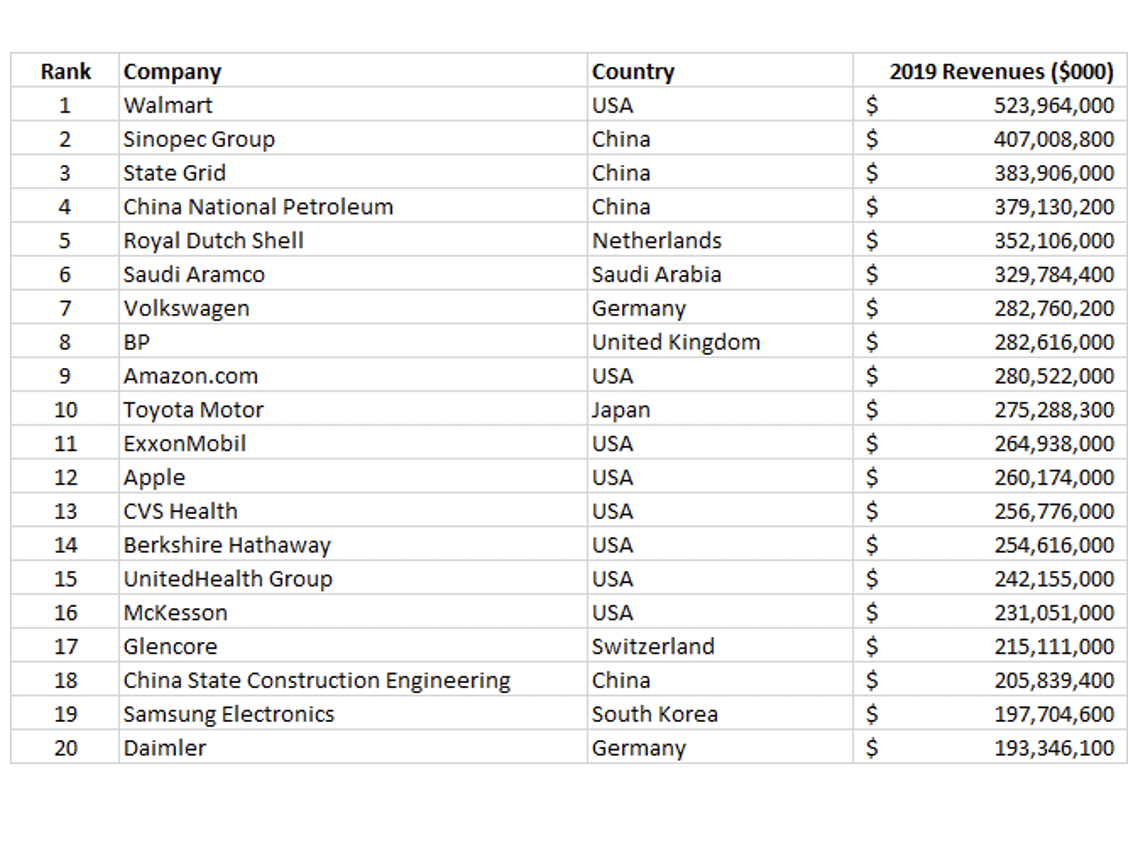
Six years ago, in 2019, it required about two hundred billion to get into the top twenty, note that Amazon ranked 9th :
While we can expect continued change in this list (and in the smaller companies below the top ones), the United States appears as strong as it has been in decades, though the names on the list have changed substantially. in 1994, Walmart had made the list (ranking 12th) but there was no sign yet of Amezon, founded that year. Not yet among the giants of the world economy were UnitedHealth, Apple, McKesson, Alphabet, CVS Health, Berskshire Hathaway, Cencora, Microsoft, JPMorgan Chase, Costco, Cardinal Health, NVidia, and Meta were not yet among the giants of the global economy.
Gary Hoover
Executive Director
American Business History Center


